



What Is the T System for Categorising French Flour? A Complete Guide
French flour labels often feature a T number: T45, T55, T65 and beyond. It’s a useful clue when you’re choosing flour for baguettes, pastry or a rustic sourdough loaf, but it doesn’t tell you everything about how that flour will behave.
Here’s how to read the T system, what the numbers mean and how to choose a flour for the bake you have in mind.
In a nutshell: The T number describes a flour’s mineral, or ash, content. A lower number usually means a whiter, more refined flour; a higher number usually means more of the grain remains. It does not tell you the flour’s protein content or dough strength.
What does the T number measure?
The “T” stands for Type. French flour is classified by the mineral matter left behind when a flour sample is incinerated in a laboratory at around 900°C. The ash result is expressed as a percentage of the flour.
Minerals are found in the grain’s outer layers, so ash content gives an indication of how much bran and germ remain after milling. The higher the ash content, the less refined the flour is likely to be. The figure is measured in a lab, not judged by colour alone.
French bakers commonly use Type numbers, while British bakers are more likely to see descriptions such as strong white, wholemeal or extraction rate. Both approaches help describe how much of the grain remains in the flour.
The important distinction: T describes ash content only. It does not directly measure protein, gluten strength or how a dough will handle. Two T65 flours can have different protein levels and behave very differently in mixing, proving and shaping.
That’s why it’s worth looking beyond the number. Milling, wheat selection and the miller’s intended use all matter. For a reliable artisan bread flour, check the product details as well as the T grade.
French flour T numbers at a glance
The figures below are a practical guide to common flour types. Mill specifications can vary, so check the details for the flour you’re buying.
ASH-CONTENT GUIDE
French type Typical ash content General description T45 Under 0.50% Very refined white flour T55 0.50–0.60% Classic French white flour T65 0.62–0.65% Traditional bread flour T80 0.75–0.90% Semi-wholemeal flour T110 1.00–1.20% Higher-extraction flour T150 1.40% and above Wholemeal or wholewheat flour Rye note: T130 is a dark rye grade, while T170 denotes very dark wholemeal rye. These are rye classifications rather than direct equivalents of the wheat-flour types above.
A T number is a category, not a complete recipe recommendation. The T65 band is a range, and millers use the type alongside a product name and a particular grist, the selected blend of grains, to describe flour for a specific job. That’s one reason two T65 flours can produce quite different doughs.
Which T flour should I use?
QUICK GUIDE: MATCH THE TYPE TO THE BAKE
- T45: Croissants, brioche, puff pastry, fine patisserie and delicate cakes.
- T55: A versatile white flour for baguettes, batards and general pastry.
- T65: Traditional-style baguettes and French country bread.
- T80: Sourdough and rustic loaves where you want a darker crumb and more grain character.
- T110 or T130: Rustic and country breads, including rye-based loaves.
- T150 or T170: Wholemeal wheat or whole-rye loaves. These are often blended with lighter flour to help the dough rise.
T45: refined flour for pastry and viennoiserie
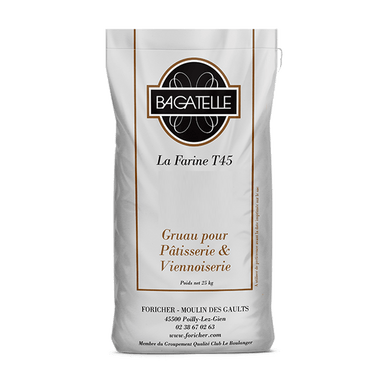
T45 is very finely milled and pale, making it a popular choice for delicate pastry and enriched doughs. For croissants and brioche, explore Foricher Bagatelle CRC® T45 Croissant & Brioche French Patisserie Flour or Moul-Bie T45 French Patisserie Violette Flour.
Some T45 flours are selected for more strength than others. “Gruau” is a useful term to look for when a recipe needs a refined flour with stronger baking performance. Our Moulin des Courtils T45 Gruau French Patisserie Flour is one option to consider. You can also explore Moulin des Courtils T45 French Patisserie Flour elsewhere in the range.
T55: a versatile French white flour
T55 is a useful all-round choice for everyday French baking, from bread to pastry. For baguettes and general bread making, Matthews Cotswold Belle Blanc French T55 Flour 1.5kg is made with 100% French wheat, while Matthews Cotswold French T55 Flour offers the same Belle Blanc flour in a 16kg size that is especially useful for busier kitchens. You can also explore Foricher Bagatelle CRC® T55 French Patisserie Flour, Shipton Mill No.2 French Type 55 White Flour and, for a more specific example of why the T number isn’t the whole story, Moul-Bie OR T55 French Bread Flour, which is listed at 10.8% protein.
T65: a traditional choice for French bread
T65 is often chosen for baguettes and country loaves. It can bring a little more grain character than a more refined white flour, but the T number alone won’t tell you how strong the dough will be. Try Foricher Bagatelle CRC® T65 Traditional French Baguette Flour, Moul-Bie Campaillette Grand Siècle T65 Traditional French Baguette Flour, Wessex Mill French Bread Flour T65 1.5kg or Moulin des Courtils T65 French Bread Flour. Several of these are specifically presented as traditional baguette flours.

T80: more grain character for rustic loaves
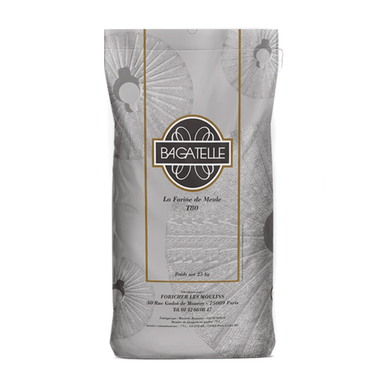
T80 is a semi-wholemeal flour, often chosen for country loaves and sourdough where a deeper flavour and darker crumb are welcome. It is not the same as wholemeal. Foricher Bagatelle French CRC® T80 Stoneground Flour is one to explore for rustic baking. For a seeded multigrain stoneground option suited to rustic loaves, consider Foricher Tour de Mains CRC® T80 Seeded Multigrain Stoneground French Bread Flour.
Higher-T wheat flour and rye
T110 and T150 wheat flours contain more of the grain’s outer layers than the lower-numbered types. They tend to absorb more water and bring a fuller flavour, though bran can make dough less elastic. A longer, slower prove or a blend with lighter flour may help suit your recipe.
For a wholemeal wheat loaf, consider Foricher Brun de Plaisir CRC® T150 French Wholemeal Flour. For rye baking, Foricher Seigle CRC® T130 French Rye Flour adds the distinctive, earthy character of rye.
Seeded, rustic and speciality French flours
Alongside the classic T grades, there are also speciality French flours and mixes designed for more distinctive loaves and pastry work. Moul-Bie Campaillou French Bread Flour is a special bread mix for rustic, flavourful sourdough-style bread with a distinctive appearance, while Moul-Bie Campagrain Dark Multicereal French Bread Flour brings added flavour and texture from a multi-cereal blend. For laminated pastries and refined baking in larger-volume settings, Matthews Cotswold French Strong Patisserie Flour (16kg) is well suited to croissants, puff pastry and showstopper patisserie.
Why can two flours with the same T number behave differently?
The T number is about ash, not gluten. It won’t tell you whether a flour is strong enough for a well-developed bread dough or delicate enough for a particular pastry. Protein percentage can offer another useful clue, but it isn’t the only factor: wheat variety, milling and the flour’s overall specification also affect performance.
Higher-extraction flours usually absorb more water and bring more flavour. They may also ferment faster and feel less elastic than a refined white flour. These are useful tendencies, not guarantees; adjust hydration and proving to suit the flour and your dough.
Certification marks can offer further information. CRC relates to certified grain selection grown according to defined environmental criteria. Label Rouge is a French quality label based on an approved specification. Neither replaces checking the flour’s intended use and baking details.
Store flour well to keep it fresh
FLOUR STORAGE TIP
Keep flour in a cool, dry place in an airtight container, away from strong smells. Higher-T and wholemeal flours contain more of the grain’s oils, so they can lose freshness sooner than refined white flour. Buy a quantity you can use while it’s in good condition and seal the bag or container between bakes.
Explore French flour at Ratton Pantry
From fine patisserie flour to baguette and stoneground options, our French flour range brings together choices for home bakers and professional kitchens. Explore our sourdough baking supplies and browse baking supplies online to find flour for your next bake.
Orders placed before 2pm Monday to Friday are dispatched the same day, with express delivery available. Bakeries and pastry kitchens can also learn about Ratton Pantry trade accounts for their wholesale baking ingredients. If you’re choosing between flour types, we’d be happy to help.
French flour T system FAQs
What does the T mean in French flour?
T stands for Type. The number indicates the flour’s mineral, or ash, content after a laboratory sample is incinerated. It gives a guide to refinement, not dough strength.
Is T65 stronger than T55?
Not necessarily. T65 has a different ash-content classification, but the T number does not measure protein or gluten strength. Check the flour’s product details and intended use.
What is the difference between T45 and T55?
T45 is more refined and is commonly used for fine pastry, croissants and brioche. T55 is a versatile French white flour used for bread and pastry. The best choice depends on the recipe and the flour’s individual specification.
Which French flour is best for baguettes?
T55 and T65 are both used for baguettes. Choose a flour sold for baguette making, and consider its product details as well as its T number.
Which French flour should I use for croissants?
T45 is a common choice for croissants and other viennoiserie. A T45 Gruau flour may be suitable when the recipe calls for a stronger refined flour.
Is T80 the same as wholemeal?
No. T80 is semi-wholemeal, while T150 is a higher-extraction wheat flour commonly described as wholemeal or wholewheat.
Why do two T65 flours behave differently?
Because T65 only describes ash content. Protein, wheat selection, milling and the miller’s intended use all influence how a flour mixes, proves and bakes.
Leave a comment